













Perpetual Futures Prop Firms:
Compare Perps Rules & Funding 2026
Compare funding treatment, price feeds, drawdown basis and payouts across prop firms that offer perpetual futures (perps).
10,000+
Active Traders
1,000+
Prop Firms Tracked
27+
Challenges
543+
Reviews
featured
most popular
cheapest
new
unverified
all firms
#
Prop Firm
Traffic
Country
Years
Max Alloc
Challenges
Platforms
PalPoints
Price
Min
Max
Discount
Actions












How Prop Firm Pal pays you back
Compare firms, save at checkout, and turn your points into a free account.
- 01 · Compare
Find the right firm
Every firm’s price, rules and payout split side by side - with our discount already on the price.
- 02 · SaveDiscount codeAppliedYou saveup to 50%
Pay less with code PAL
One code, up to 50% off at verified firms. Copy it, paste it at checkout, done.
- 03 · Earn+100Sign-up bonus+100 PalPointsVerified purchase+ PalPointsApproved review+ PalPoints
Collect PalPoints as you go
100 points free the day you sign up, then more for every verified purchase and approved review.
- 04 · RedeemFREEACCOUNT
$10,000 Three Step Challenge (Standard)
105,000 PalPointsSpend them on a real account
16 prop firm challenges in the PalPoints shop, from 3,500 points - paid for with points, not cash.


PalPoints are credited to your Prop Firm Pal dashboard.
Browse Prop Firm Lists
Rankings by country, platform, assets, challenge type and more-built from live firm data.
Countries
Prop firms that accept traders from your country or region.

Platforms
MT5, cTrader, TradeLocker and other supported trading platforms.
Assets
Forex, crypto, futures, stocks and other tradable asset classes.

Features
Instant funding, scalping rules, profit splits and program benefits.
Challenges
One-step, two-step, instant funding and evaluation program types.
Trader types
Beginners, scalpers, swing traders and other trading styles.

Payment methods
Card, crypto, bank transfer and other ways to pay for challenges.

Payout methods
How firms pay traders-Wise, crypto, bank wire and more.

Read before you buy
Firm verdicts, reviews and beginner guides, written from our firm data.
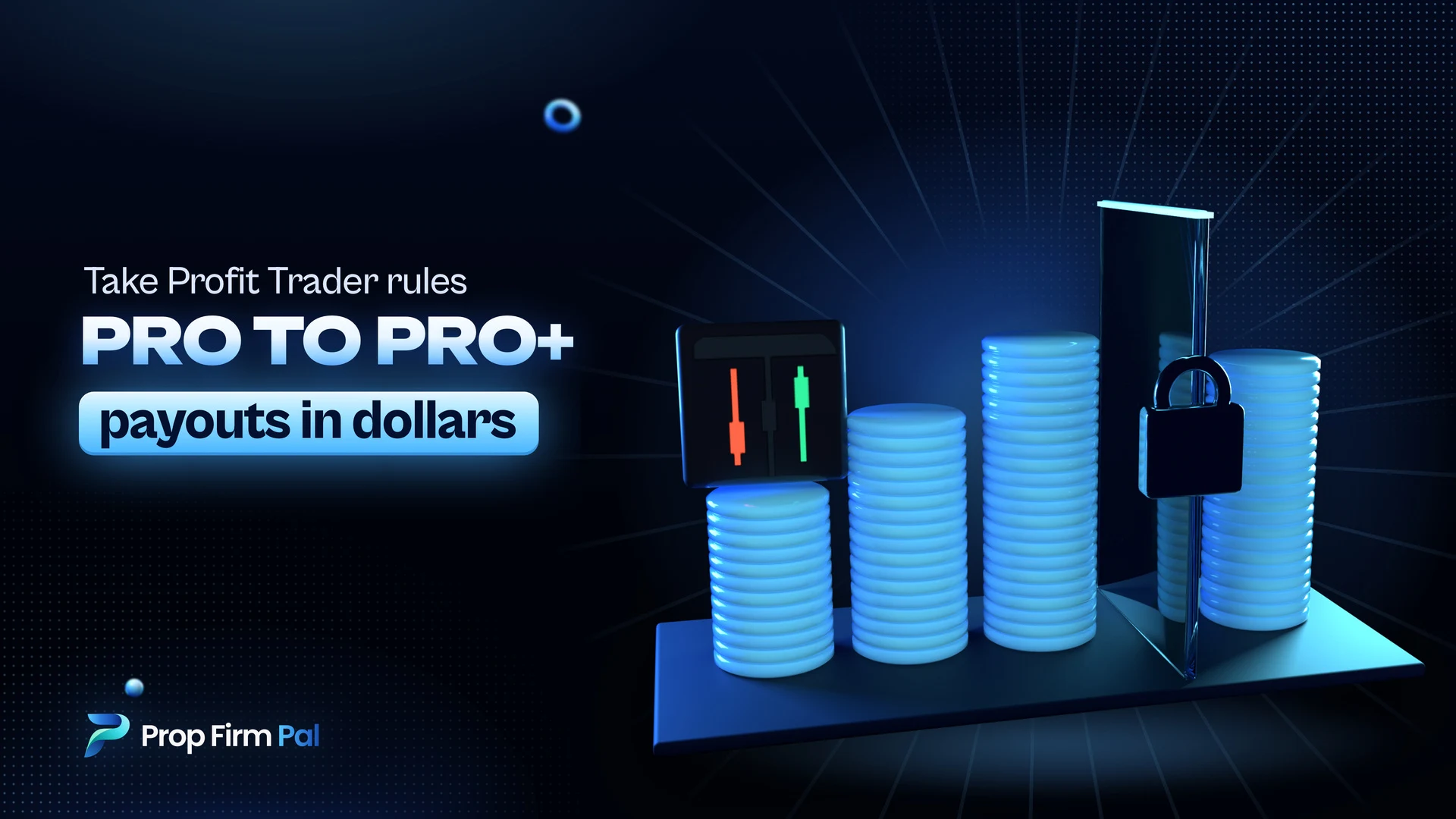
Take Profit Trader Rules: PRO to PRO+ Payouts in Dollars
Take Profit Trader's $50K path in dollars: $300 to start, $2,375 of PRO profit to recover it, and $5,000 frozen on the move to PRO+.


A Beginner's Guide to Prop Trading with Lark Funding (2026)
An educational walkthrough of proprietary trading using Lark Funding's 1‑Step, 3‑Step, and Instant challenges as examples.


A Beginner's Guide to Funding Traders: Challenges, Rules & What to Expect in 2026
This guide walks complete beginners through how proprietary trading firms work, using Funding Traders as a detailed example. Understand challenge types, profit splits, drawdown rules, and what to…


Is Blueberry Funded Worth It in 2026?
Blueberry Funded offers broker-backed credibility and a wide challenge menu, but the 1.5% risk-per-trade rule and restricted countries list create real friction. Here's whether the math works for you.

Latest posts
16


Firms we’ve covered
11







Why Perps Traders Trust Prop Firm Pal?
Evaluation rules, funding treatment and payouts for perps prop firms, taken from what each firm publishes. Unknown is shown as unknown.

Perps Prop Firm Listings
Drawdown basis, payout schedules and account sizes for every perpetual futures prop firm we list, on one page.

Side-by-Side Funding Comparisons
Compare firms on how funding is applied, whether it counts toward drawdown, and where prices come from.

Perps Trader Reviews
Verified traders report on payout speed, platform stability and the risk rules specific to perpetual futures.

Perps Rule Breakdowns
Plain summaries of funding, drawdown and payout rules, so you can judge a perps prop firm before paying.
More than a comparison
Make an account and the site starts paying you back.
Earn points for what you already do
Start with 100 free on sign-up. Points land in your dashboard and spend in the PalPoints shop.
Score a firm you’ve traded with.
Bought with code PAL? Verify it.
Trade your balance for a free account.
Win free accounts
Enter Prop Firm Pal giveaways to win free prop firm accounts and challenges.

The community
Our videos, live broadcasts, trader groups and articles, all in one place.
FAQs - Prop Trading Questions Answered
Answers on prop firms, funded accounts, challenges and how our platform works
Perpetual futures, or perps, are derivative contracts that track an asset's price and have no expiry date. Because there is no settlement date, longs and shorts exchange a periodic funding payment that keeps the contract close to the underlying index price. Traders use them for leverage and for easy shorting, most often on crypto assets such as BTC and ETH.
Perps is short for perpetual futures, the crypto derivative contracts that have no expiry date and stay near spot through regular funding payments between longs and shorts. Traders hold perps instead of spot when they want leverage, to go short, or to avoid moving coins. Perps trade around the clock on both centralized and on-chain venues.
Perpetual futures work by letting you hold a leveraged long or short position with no expiry, backed by margin and marked against an index price. Every funding interval, traders on one side pay the other an amount based on the funding rate and position size. You stay in the trade until you close it or the position is liquidated.
Regular futures have a fixed expiry date and settle or roll, often on regulated exchanges such as CME, while perpetual futures never expire and use funding payments to stay aligned with spot. Perpetuals usually trade around the clock, including weekends, while dated futures keep exchange hours. Funding replaces the expiry convergence you would otherwise rely on.
Spot trading means buying the asset itself, while perpetual futures are a contract on its price that you can trade with leverage and short just as easily as you can buy. A spot position carries no funding payments or liquidation risk if unleveraged. A perpetual position can pay or earn funding and can be liquidated if margin runs out.
Bitcoin perpetual futures are contracts that track the price of BTC with no expiry date, and they are usually the deepest and most liquid perpetual market on any venue. You can go long or short with leverage, and you pay or receive funding at regular intervals. At a prop firm, BTC limits and fees are set by the firm.
Perpetual futures are now available to some US traders: in May 2026 the CFTC approved a Bitcoin perpetual contract listed by Kalshi, and similar regulated products may follow. Most offshore perpetual venues still exclude US persons. Prop firms set their own country rules regardless, so check a firm's eligibility terms and our guide to US and UK access before buying an evaluation.
Perpetual futures are high risk, mainly because leverage can magnify losses and a position can be liquidated quickly if the market moves against your margin. Funding adds a running cost or credit you may not expect, and thin markets can move sharply. At a prop firm the risk shifts to the evaluation fee, but your loss limit applies at all times.
A funding rate is a periodic payment between long and short holders of a perpetual futures contract, usually quoted as a small percentage of position size. When the rate is positive, longs pay shorts, and when it is negative, shorts pay longs. The rate moves with the gap between the contract price and the index price.
A positive funding rate means long positions pay short positions, which usually happens when the perpetual contract trades above its index because buyers are the more aggressive side. Traders often read a persistently high positive rate as crowded long positioning. It is a sign of positioning rather than a price forecast, and it costs longs for as long as it lasts.
A negative funding rate means short positions pay long positions, which usually happens when the perpetual contract trades below its index because sellers are the more aggressive side. Traders often read a persistently negative rate as crowded short positioning. A long position can earn funding in that state, but the funding received may not offset a further fall in price.
The funding rate is a positioning signal rather than a reliable bullish or bearish one: a high positive rate shows crowded longs and a negative rate shows crowded shorts, and either can continue for some time. Extremes can come before a sharp reversal when a crowded side is forced out, so most traders use funding alongside price and open interest.
Stuck on a firm? Ask us.
Questions about a firm’s rules, which account to buy, or your PalPoints. Message the team and a person replies.


Stay Ahead in Prop Trading
Compare verified firms, grab exclusive deals, and enter free challenge giveaways up to $200K.
Resources
Statistics
Tools
All information provided on this site is intended solely for educational purposes related to trading on financial markets and does not serve in any way as a specific investment recommendation, business recommendation, investment opportunity analysis, or similar general recommendation regarding the trading of investment instruments.
Prop Firm Pal provides comparison, review, and educational resources only. We do not operate as a proprietary trading firm, broker, or custodian, do not offer simulated trading accounts or evaluations, and do not provide execution or custody of funds.
The information on this site is not directed at residents in any country or jurisdiction where such distribution or use would be contrary to local laws or regulations.
Prop Firm Pal does not act as a broker and does not accept any deposits.
Data, tools, and third-party references on this site are provided for informational purposes; availability and accuracy may depend on third-party sources outside our control.
© 2026 Prop Firm Pal. All rights reserved.