
Prop firm drawdown comes in four types: a daily limit, a static floor, an end-of-day (EOD) trailing floor and an intraday trailing floor. They decide how much you can lose before the account closes, and on the same balance they can leave very different room. In the worked example below, a $100,600 balance has $3,600, $1,600 or $900 of room left depending on the type. This is general information, not trading advice.
- Static floor
- Never moves
- EOD trailing
- Moves at the close
- Intraday trailing
- Moves on open profit
- Daily limit
- Resets each day
- Gentlest at equal dollars
- Static
- Tightest at equal dollars
- Intraday trailing
The four drawdown rules
Each rule draws a floor under your account. Touch the floor and the rule fires. The difference is what moves the floor and when.
Static
The floor is set on day one and stays there. A $100,000 account with $3,000 of room fails at $97,000, however much it makes first.
EOD trailing
The floor follows your best closing balance. It moves once a day, so open profit you give back before the close costs nothing.
Intraday trailing
The floor follows your highest balance, including open profit, in real time. Open profit you give back still raises the floor.
Daily limit
A second floor that resets each day. It sits alongside one of the other three. Some firms close the account when it is hit and others pause you until the next session.
Three formulas give your room at any moment, before any lock applies:
- Static: current equity minus the fixed floor.
- EOD trailing: the maximum loss minus the gap between your best close and current equity.
- Intraday trailing: the maximum loss minus the gap between your highest peak and current equity.
Our trailing drawdown calculator runs these on your own numbers.
Same six days, four different results
Run one path through all four rules and three of them fail on different days, while the static account finishes up $1,400. The path is illustrative and built to separate the rules. Every account starts at $100,000 with $3,000 of room, the same figure Topstep, Apex and LucidFlex set on a 100K account. The daily limit is $1,500 from each day's opening balance.
| Day | High | Low | Close |
|---|---|---|---|
| 1 | $101,800 | $100,000 | $100,900 |
| 2 | $102,700 | $100,700 | $102,000 |
| 3 | $102,100 | $100,400 | $100,600 |
| 4 | $100,700 | $99,500 | $99,800 |
| 5 | $99,900 | $98,900 | $99,300 |
| 6 | $101,500 | $99,200 | $101,400 |
Illustrative equity path, including open profit and loss. Not a real trading record.
| Day | Static | EOD floor | Intraday floor | Daily floor |
|---|---|---|---|---|
| 1 | $97,000 | $97,000 | $98,800 | $98,500 |
| 2 | $97,000 | $97,900 | $99,700 | $99,400 |
| 3 | $97,000 | $99,000 | $99,700 | $100,500 (hit) |
| 4 | $97,000 | $99,000 | $99,700 (hit) | |
| 5 | $97,000 | $99,000 (hit) | ||
| 6 | $97,000 |
Intraday floor shown at the end of each day. EOD and daily floors are the levels in force during that day.
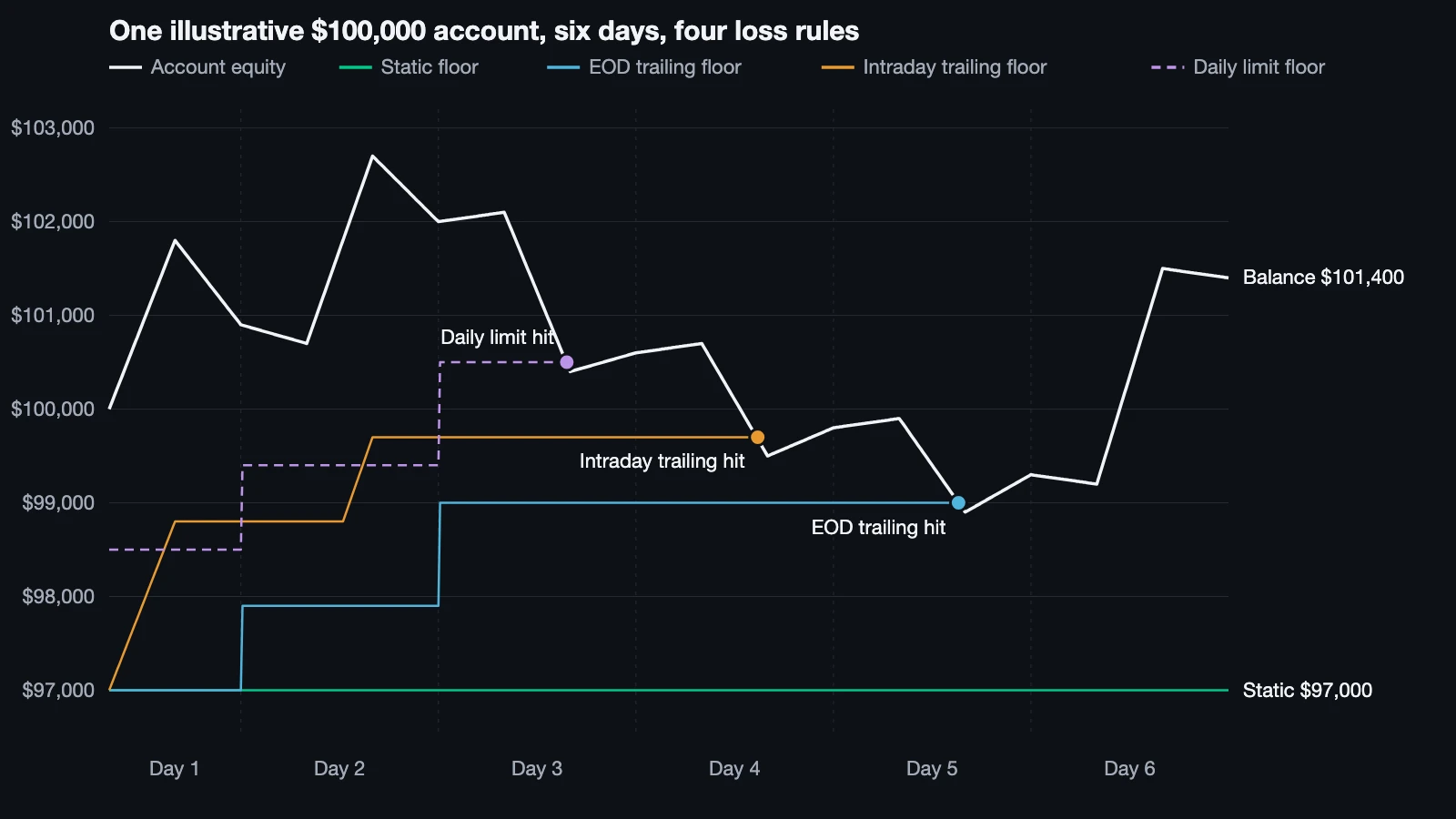
The day to look at is Day 4. The static, EOD and intraday accounts all open on $100,600, yet the room differs:
The $700 gap between the two trailing accounts comes from Day 2. The trade peaked at $102,700 and the day closed at $102,000. The intraday floor counted the peak and the EOD floor counted the close. A static floor counts neither, so its lowest point in the run, $98,900, still left $1,900 of room.
A trailing floor can never sit below a static floor with the same starting room. If a static plan offers equal dollars, it is the gentler rule on every path. Firms rarely offer that for free, as the section on static plans shows.
EOD drawdown can still fail you mid-session
EOD describes when the floor moves. At Topstep, Apex, Alpha Futures and Take Profit Trader, the check against that floor runs all day, open losses included.
The MLL updates at the end of each trading day but is monitored in real time throughout the session.
Topstep, Maximum Loss Limit
In Topstep's example the limit is $48,000 and an open trade takes the account to $47,750. Liquidation fires and slippage returns a final balance of $48,050. It still counts as a breach, because the touch came first. Apex says the same of its threshold, which is calculated at the end of the day and enforced in real time.
When does a trailing drawdown stop?
Most of the trailing floors we read stop moving at or just above the starting balance. Once that happens, each extra dollar of profit adds a dollar of room. The stopping point varies, and on some accounts there is none. Here is the room below a new closing high on a $100,000 account with $3,000 of room:
| Closing high | Static | Stops at start | Stops at start +$100 | Never stops |
|---|---|---|---|---|
| $100,000 | $3,000 | $3,000 | $3,000 | $3,000 |
| $101,000 | $4,000 | $3,000 | $3,000 | $3,000 |
| $103,000 | $6,000 | $3,000 | $3,000 | $3,000 |
| $104,000 | $7,000 | $4,000 | $3,900 | $3,000 |
| $106,000 | $9,000 | $6,000 | $5,900 | $3,000 |
Calculated from the rules below. Illustrative account, as of 6 Nov 2026.
- Stops at the starting balance: Topstep, Alpha Futures and Take Profit Trader's test account.
- Stops at start plus $100: LucidFlex, Bulenox Fast Track and Apex Performance Accounts. Apex's 50K stops at $50,100 once the balance reaches $52,100.
- Depends on the platform: Apex evaluations on Rithmic and Wealthcharts stop at the target balance, $53,000 on a 50K. On Tradovate they trail indefinitely, which is the last column above.
The level to watch on a locking account is where the lock happens. With $3,000 of room, the first $3,000 of closing profit gives you no extra room at all.
How daily drawdown is calculated
A daily limit is measured from a baseline set at the daily reset, and firms choose that baseline differently. FTMO takes the balance at midnight CE(S)T and subtracts a fixed percentage of the initial capital. Funding Pips and The5ers use the higher of balance or equity, which makes a difference if you hold a trade through the reset.
A $100,000 balance, a $2,000 open winner, a 3% daily limit
- FTMO 1-Step: $100,000 balance minus 3% of initial capital gives a floor of $97,000. From $102,000 of equity, you have $5,000 of room.
- Funding Pips 2 Step Pro: the higher value is $102,000 equity. 3% is $3,060, so the floor is $98,940. You have $3,060 of room.
- The gap is $1,940, on the same position with the same stated 3%.
An open loss works the other way on both firms. Hold a $1,000 floating loss through the reset and equity opens at $99,000 against a $100,000 balance. The floor is $97,000, so you start the day with $2,000 of room. Yesterday's open loss is using up today's limit.
What happens when the limit is hit matters just as much. FTMO and Funding Pips treat it as a breach. Apex, Topstep, LucidDaily and Bulenox's EOD option stop you for the rest of the session, and the account stays open. On the Day 3 path above, a pausing limit would have stopped the trader without ending the account.
What each firm uses
Most firms use different rules on different plans, so check the exact plan you are buying.
| Plan | Max loss | Floor moves | Stops at | Daily limit |
|---|---|---|---|---|
| FTMO 2-Step | 10% | Never | Fixed | 5% |
| FTMO 1-Step | 10% | Midnight balance | None stated | 3% |
| Funding Pips 2 Step Pro | 6% | Never | Fixed | 3% |
| Funding Pips Zero | 5% | Equity high | Breakeven | 3% |
| The5ers 2-Step | 10% | Never | Fixed | 3% |
| Topstep 100K | $3,000 | Daily close | Start | Optional |
| Alpha Futures Zero 100K | $3,000 | Daily close | Start | $2,000 |
| Apex Intraday 100K | $3,000 | Live peak | PA: start +$100 | None in eval |
| Apex EOD 100K | $3,000 | Daily close | PA: start +$100 | $1,500 in eval |
| LucidFlex 100K | $3,000 | Daily close | Start +$100 | Optional |
| Take Profit Trader test 100K | $3,000 | Daily close | Start | None |
| MFFU Studio #002 ($20K) | $1,000 | Never | Fixed | None |
From each firm's own rules pages, read on 6 Nov 2026. Rules change, so confirm before you buy. You can line firms up on our compare page.
The rule can change after you pass
Passing on an EOD evaluation does not always mean an EOD funded account. Three plans switch to intraday trailing at the funded stage:
- LucidDaily: you can pick EOD or intraday for the evaluation, but its page says all funded accounts use intraday drawdown.
- Take Profit Trader: the test is EOD. PRO accounts trail intraday on peak balance, including unrealised gains, until the floor reaches the starting balance.
- MFFU Rapid: the evaluation is EOD, and Sim Funded is intraday trailing until the floor locks at +$100.
A trader who passed by letting winners swing can then give back open profit in a way the evaluation never punished. Bulenox works differently: you choose trailing or EOD at purchase and that choice lasts for the life of the account.
FTMO's 1-Step has its own reset. When a Reward is withdrawn and a new account is issued, the Maximum Loss Limit returns to 90% of initial capital.
Prop firms without trailing drawdown
CFD firms mostly use static floors and futures firms mostly trail. By Prop Firm Pal's count of plans at active firms, as of 6 Nov 2026:
That is the usual trade. A static CFD plan tends to add a daily limit, while a trailing futures plan often has none, or makes one optional. Plans with a static floor include:
- CFD: FTMO 2-Step, Funding Pips 2 Step Pro and The5ers 2-Step, each with a daily limit.
- Futures: MFFU Studio, with no daily limit and micros only. Its $500, $1,000 and $250 floors carry through to Sim Funded, and the Live stage trails EOD until it locks.
- Futures: BluSky's 200K Orbit at $3,000, and its help centre also lists Static Growth evaluations at $1,000 on the 150K and $2,000 on the 200K. The dollar room is small for the size.
At MFFU, Apex and Lucid, the gentler rule costs more. MFFU Studio #001 charges $140 for $500 of static room, or $280 per $1,000. MFFU Rapid EOD 25K lists at $145 for $1,000 of room, though Studio also drops the 30% consistency rule and four-day minimum. At Apex, the 100K Standard evaluation lists at $790 on intraday and $1,190 on EOD, or $79 and $119 with the coupon shown on 6 Nov 2026. LucidDaily's page likewise says EOD costs more than intraday. See more on our static drawdown and trailing drawdown lists.
Which drawdown type suits how you trade
Match the rule to the size of your open swings and to whether you hold through the reset.
- You let winners run and give back open profit: intraday trailing is the hardest fit. The give-back in the example cost $700 of room in a single day.
- You take quick profits and rarely give back: intraday trailing costs you less, and it can be the cheaper evaluation.
- You hold overnight: check the daily baseline. A higher-of-equity rule raises the floor on open winners.
- You sometimes have one large losing day: a pausing daily limit ends the day, while a breach limit ends the account.
- You plan to stay funded: read the funded rules first, then the evaluation rules. Payouts can move the floor too. A Topstep Express Funded Account starts from a $0 balance, and its floor is set to $0 after the first payout.
To size positions against your floor, use the drawdown calculator.
Common questions
What is drawdown in a prop firm?
It is the loss limit on your account, set as a floor your equity may not touch. Many plans add a daily limit on top of the overall floor.
Which is better, static or trailing drawdown?
With equal dollars, static, because its floor can never be higher than a trailing one. Static plans often offer less room or cost more, so compare the dollars and the price too.
Does FTMO have a trailing drawdown?
On the 1-Step, yes. FTMO calls it an end-of-day trailing limit, recalculated at midnight CE(S)T from the highest midnight balance. The 2-Step limit is static. Both were read on 6 Nov 2026.
Can I fail an EOD account during the day?
Yes, at firms that enforce it live. Topstep, Apex, Alpha Futures and Take Profit Trader all move the floor at the close and check it in real time, with open losses included.
Does hitting a daily loss limit fail the account?
It depends on the firm. FTMO and Funding Pips treat it as a violation. Apex, Topstep and LucidDaily pause trading until the next session.
Sources
- FTMO, Trading Objectives
- Funding Pips, 2 Step Pro Model
- Funding Pips, FundingPips Zero
- The5ers, 2-Step Plan Rules
- Topstep, Maximum Loss Limit
- Topstep, Daily Loss Limit
- Alpha Futures, Maximum Loss Limit
- Apex, EOD Drawdown Explained
- Apex, Intraday Trailing Drawdown Explained
- Apex, Daily Loss Limit Explained
- Lucid Trading, LucidFlex Drawdown
- Lucid Trading, LucidDaily Customization
- Take Profit Trader, Rule 3
- Take Profit Trader, PRO Account Rules
- My Funded Futures, Studio Plans
- My Funded Futures, Rapid
- My Funded Futures, Rapid EOD
- Bulenox, Accounts and Pricing
- Bulenox, Fast Track Account
- BluSky, Static Growth Plan
- BluSky, Orbit Plans