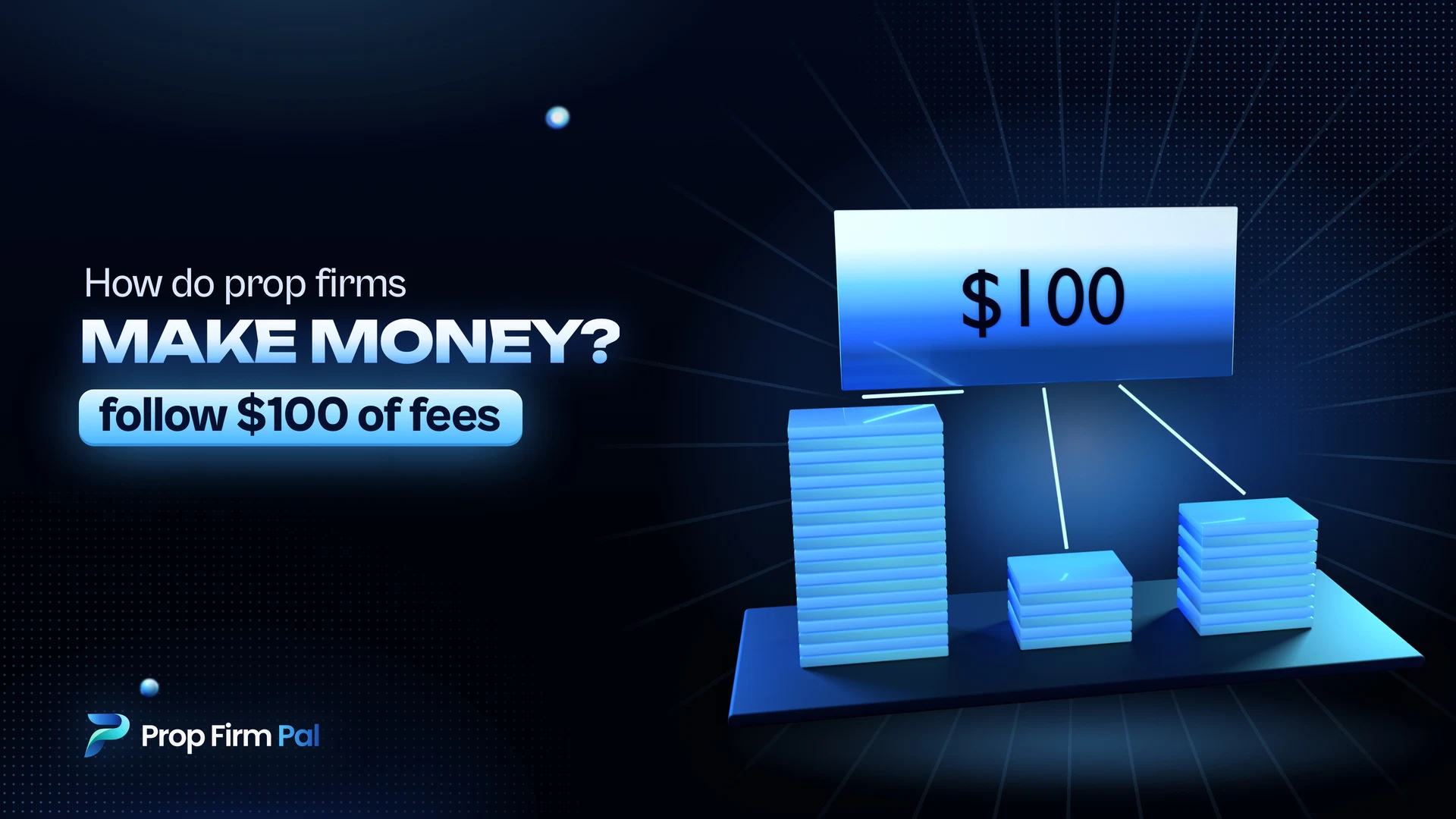
Prop firms make most of their money from fees, and they pay trader rewards out of those fees. The best public record of how that splits comes from FTMO's filed accounts. In 2024, each $100 of FTMO's fee revenue became about $55 of trader rewards and payout costs, $17 of other costs and $28 of net profit. In 2025 the profit share fell to $8.90, the lowest margin in the six years we can see.
- Main income
- Entry and add-on fees
- Rewards and payout costs per $100 (FTMO 2024)
- About $55
- Net profit per $100 (FTMO 2024)
- About $28
- Net profit per $100 (FTMO 2025)
- $8.90
- Paid orders per reward (FTMO)
- About 14
- Topstep Combines passed, 2025
- 16.8%
What is a prop firm, in money terms?
A retail prop firm sells access to a test on a simulated account, then shares rewards with the traders who pass and keep to its rules. You pay a fee, trade to a profit target under loss limits, and if you pass you can ask for a share of the profit on a funded-stage account. Our comparison table shows those terms side by side.
The funded stage is usually simulated too. FTMO says so in its site footer:
all accounts we provide to our clients are demo accounts with fictitious funds and any trading is in a simulated environment only
FTMO, homepage notice
Topstep describes its Trading Combine and Express Funded Accounts as "realistic simulations" on its disclosures page. That page also says 0.71% of participants in an Express Funded Account were called up to a Live Funded Account in 2025. So a reward is a payment from the firm, sized by simulated results, and fees are the main income it can come from.
Where does $100 of fees go?
At FTMO in 2024, a little over half went out through the companies that pay traders, and more than a quarter was profit. FTMO is the useful case because Czech companies file accounts, while most prop firms publish nothing comparable.
| Each $100 of FTMO revenue, 2024 | Amount | Underlying figure |
|---|---|---|
| Rewards and payout costs | $55 | CZK 3.66bn |
| All other costs | $17 | The remainder |
| Net profit | $28 | CZK 1.89bn |
Our calculation from the 2024 accounts of FTMO's evaluation company, which sells challenges, its trading company, which handles funded traders, and FTMO s.r.o., all filed in the Czech company register. Revenue from customers was CZK 6.71bn, about $289M at the 2024 average exchange rate. The filings call the payout line a cost of running the trading platform, and TradeInformer reads it as payouts. FTMO refunds the 2-Step fee with the first reward. The evaluation company books expected credit notes as lower revenue, so this revenue is probably after those refunds.
This share moves a lot from year to year. The same lines give about $45 per $100 for 2023, using the restated figures in the 2024 accounts, and about $65 for 2025. Treat them as an upper limit for rewards alone. FTMO's own payout post gives $75.2M of rewards for 2023, about CZK 1.67bn at that year's average rate, or 84% of that year's line.
Before any of this, part of the list price has often gone already. The codes on our offers page have a median of 15% across the 25 firms that list one. Referrers take a cut as well. On the firms' own affiliate pages, FTMO states 8% to 20% on challenges and FundedNext states 10% to 15% on a first CFD purchase, as our guide to affiliate links and codes sets out. Prop Firm Pal earns commission of this kind too.
Illustrative only: a $100 list price before it reaches the firm
- List price: $100.
- A 15% code takes it to $85, the amount you pay.
- A 10% commission on that $85 is $8.50 to the referrer.
- The firm has $76.50 left, before card fees, rewards or anything else.
How many fees pay for one reward?
Roughly 14 to 20, on two separate estimates from FTMO's figures. An average reward is many times the fee, so the sums only work if rewards are much rarer than purchases.
FTMO prints an average reward for each 2-Step account size in the pricing data on its homepage. Few firms publish this.
| 2-Step account | Fee | Average reward | Reward as a multiple of the fee |
|---|---|---|---|
| $10,000 | €89 | €680 | 7.6 |
| $25,000 | €250 | €1,431 | 5.7 |
| $50,000 | €345 | €2,805 | 8.1 |
| $100,000 | €540 | €5,957 | 11.0 |
| $200,000 | €1,080 | €12,234 | 11.3 |
Fees and rewards from FTMO's site, read on 6 November 2026, at list price. The $100,000 account was on offer at €439 that day. Multiples are our calculation.
The first estimate uses the 2024 split. At $55 per $100, each €540 fee funds about €297 of rewards and payout costs, so one €5,957 reward uses that share of about 20 such fees.
The second estimate counts orders. FTMO had 1.27 million paid orders in 2025, or about 105,800 a month. It reported 7,500 payouts in August 2026 and about 7,100 in September. That is about 14 orders for each reward. The periods differ by a year and one trader can collect many rewards, so treat it as a scale check.
Returning customers made up almost 80% of 2025 turnover, according to FTMO's annual report. That group can include people who failed and tried again and people who passed and bought more, and the report doesn't separate them. Either way, repeat purchases carry this business.
How many traders actually get paid?
The published figures run from about 1% to about 17% of participants, and they don't share a definition. Read each one for what it counts.
| Source | Reached funded stage | Of those, received a payout | Period |
|---|---|---|---|
| Topstep | 16.8% of Combines; 51.8% of individuals | 33.3% of individuals at funded level | 2025 |
| FPFX Tech, 10 firms | 14% of traders | About 45%, or 7% of all traders | Reported 2024 |
| The Funded Trader's CEO | 5% to 10% | About 20%, or 1% to 2% overall | Reported 2025 |
| Fintokei | 23% | Not stated | 2024 |
Company statements, none presented as audited. Topstep's statistics cover simulated and live accounts together.
Topstep's two figures show why the denominator matters. Only 16.8% of Combines passed, yet 51.8% of people passed at least one, because people retry. Multiply 51.8% by 33.3% and you get about 17% of starters, or 1 in 6, as a rough figure. The two percentages are measured on different groups, so it can't be exact.
FPFX's data shows the same habit from the spending side. Its average account holder took about three challenges and spent about $800, and the average payout was about 4% of the plan size. On a Topstep $50K account, the retry maths looks like this.
Illustrative: the average cost of reaching Topstep's funded stage
- At 16.8% per Combine, the average pass takes 1 ÷ 0.168 = about 6 attempts.
- If each attempt costs one $49 monthly payment, that is about $292.
- Add the $149 activation fee on the Standard path: about $441.
Your own number depends on how you trade. This uses an average across all Combines in 2025.
What else do prop firms charge for?
Activation fees, monthly billing, resets and reactivations all add income after the headline price, and they change what a cheap entry fee really costs.
| Firm | How the entry fee works | After you pass | Top split |
|---|---|---|---|
| FTMO 2-Step | One-time, €540 at $100K, refunded after the first reward | No further fee | 90% |
| Topstep Standard | Monthly: $49, $99 or $199 at $50K, $100K or $150K | $149 activation; Back2Funded reactivation $599 to $829 at those sizes | 90% |
| Apex Intraday Standard | One-time, $790 list at $100K, $79 under its 90% off banner | $129 activation at $100K; 6 payouts maximum per account | 100% |
From each firm's own pages, read on 6 November 2026. Prices change often, and Apex's banner discount may not last.
Apex shows how far a list price can sit from the real one. At 90% off, the $129 activation fee is larger than the $79 entry fee, so a trader who passes first time pays more after the pass than before it. Compare total cost before you compare banners.
What does a typical payout look like?
Smaller than the headlines, and very unevenly spread. Instant Funding links its payout wallets from its homepage, so anyone can read the transfers. We pulled every stablecoin transfer out of its Ethereum and Tron wallets from 8 March 2024 to 11 June 2026.
Our analysis of public on-chain data from wallets 0x9c555ff06a01bb950e9cf3cb9ed5178644669137 and TXfBsYCBDEucL5JfauosiuPviF8aqVAG1A, $6.09M in total.
This is one firm that sells accounts from $625, on its crypto route only. These wallets carried about $3.36M in 2024, around two-thirds of the $5.04M the firm states for that year, and little after mid-2025. A transfer doesn't say what it was for, so some may be commissions or refunds, and one trader can use several wallets. FTMO's reported average of about $2,030 per reward in September 2026 is much higher.
Most transfers here are small, and a small group of wallets takes most of the dollars. Our payouts page shows what firms report.
What can break the model?
Rewards rising faster than fees. In 2025 FTMO's payout line rose about 54% while revenue rose 31%. Because rewards arrive after the fees are collected, a firm has to estimate them, and that estimate can be badly wrong. FTMO's six-year record shows how margin has shrunk while revenue grew eightfold.
Net margin of FTMO s.r.o., from its filed accounts, with 2023 as restated a year later. Revenue went from CZK 1.11 billion to CZK 8.81 billion. Most of that revenue is billed to other FTMO companies. Its parent, OMHC, reports lower consolidated profit after goodwill write-offs and other businesses: CZK 1.31 billion in 2024 and CZK 48 million in 2025.
2025 is the clearest example. FTMO had reserved CZK 523 million at the end of 2024 for rewards still to come. The real figure was about CZK 955 million, more than 80% higher. It raised its reserve to about CZK 1 billion, and CZK 479 million went through operating costs. Co-founder Marek Vašíček blamed US tariff shocks and demand for safe assets, which he said squeezed margins across the sector.
| Each $100 of FTMO s.r.o. revenue, 2025 | Amount |
|---|---|
| Platform and payout costs billed by group companies, $56.00 in 2024 | $64.80 |
| Advertising on social networks, up 85% on the year | $8.40 |
| Extra provision for trader rewards | $5.40 |
| Net foreign exchange loss | $2.20 |
| Bank fees on the loan for buying Oanda | $0.80 |
| Operating profit | $13.90 |
| Net profit | $8.90 |
Selected lines only, so they don't add to $100. Our calculation from the 2025 accounts, rounded to 10 cents, on revenue of CZK 8.81bn.
The 2024 split shows how thin the cushion is. With payout costs at $55 and pre-tax profit at about $35, a rise of about 60% in the payout line would take pre-tax profit to zero if nothing else moved. FTMO has scale behind it, and it was still growing, up 25% in the first half of 2026 according to co-founder Otakar Šuffner. A smaller firm with thinner reserves has less room when traders do well.
What this means when you buy a challenge
Judge a firm on total cost and on what it publishes. The firm earns on the fee whether or not you pass, so the fee is the one number fully in your control.
| $100K plan type | Median list fee | Firms | Simulated profit to earn the fee back at 90% |
|---|---|---|---|
| Futures evaluation | $255 | 25 | $283 |
| CFD 2-step | $475 | 21 | $528 |
| CFD 1-step | $534.50 | 24 | $594 |
| Futures straight to funded | $658 | 10 | $731 |
| CFD instant | $694 | 17 | $771 |
Cheapest $100K plan at each verified firm on Prop Firm Pal, USD list prices before codes, as of 6 November 2026. Excludes activation and later fees. Some futures plans bill monthly. The median top split across these firms is 90%.
- Work out your recovery number. Divide everything you will pay by your split. A $475 fee at 90% needs $528 of paid-out simulated profit before you are ahead, about 0.5% on a $100K account, and only after you have passed.
- Add the fees that come after the pass. Include activation, monthly billing and resets. Topstep's $49 plan becomes about $441 on the average path worked above.
- Check the refund. FTMO refunds the 2-Step fee after the first reward, but not the 1-Step or Instant fee. Many firms refund nothing.
- Check the payout limits. Caps per payout and a maximum number of payouts decide what the split is really worth. Our calculators help with the sums.
- Prefer firms that show their working. Average rewards, pass statistics and payout wallets are all things some firms publish. If a firm shows none of them, you can't tell how much it pays out.
Common questions
Do prop firms make money when you fail?
Yes. The firm keeps the fee, and that fee helps fund rewards for those who pass. It also earns when you pass and buy again, and it pays out when you win, so its income depends on the balance across all traders.
Do prop firms make money from trading?
Retail evaluation firms make their money mainly from fees. FTMO says its accounts are demo accounts, and Topstep says 0.71% of Express Funded participants were called up to a live account in 2025. Neither source reports a figure for income from real trading.
What is a prop firm?
A retail prop firm sells a paid evaluation on a simulated account and shares rewards with traders who pass and follow its rules. You risk the fee, and the firm doesn't ask you to deposit trading capital.
How much do prop firms keep?
Very few firms publish this. FTMO's net profit was $28 per $100 of revenue in 2024 and $8.90 in 2025, after peaking at $64.80 in 2020 in the years we can see.
Can a prop firm run out of money?
It can, if rewards outrun fees and it has too little in reserve. FTMO's actual rewards for 2024 revenue came in more than 80% above its reserve, and it could absorb that. You generally can't see a smaller firm's reserves, so look at its payout record and how recently it paid.
Sources
- Czech company register: FTMO s.r.o. filed accounts, 2020 to 2025
- Czech company register: FTMO Evaluation Global filed accounts
- Czech company register: FTMO Trading Global filed accounts
- CzechCrunch: FTMO's 2025 revenue, profit and margin record
- TradeInformer: How does FTMO make money?
- TradeInformer: What FTMO tells us about prop firm finances
- Finance Magnates: FTMO monthly rewards
- Finance Magnates: FPFX Tech data on 300,000 accounts
- Finance Magnates: The Funded Trader's pass rates
- FX News Group: FTMO's 2025 results
- Topstep: Disclosures and 2025 trader performance statistics
- FTMO: homepage, pricing and average rewards
- FTMO: Why is there a fee?
- FTMO: payout history